
Producing aggregates that meet specific construction standards requires more than selecting a crusher with the correct output capacity. In an aggregate crushing plant, the screen aperture directly influences finished product grading, material circulation, and overall production efficiency. Even when the crushing equipment operates normally, an incorrectly selected screen opening can result in excessive oversized particles, unwanted fines, or unnecessary recirculation.
The key is to work backward from the required aggregate specifications and determine how screen openings, crusher settings, and material characteristics interact. Understanding these relationships helps quarry operators improve product consistency while controlling operating costs.
What Determines the Correct Screen Aperture?
Screen aperture refers to the size of the opening through which particles can pass. It is generally expressed in millimeters and determines the nominal separation size of a vibrating screen. However, selecting an aperture is not simply a matter of matching the opening to the desired aggregate dimension.
Understand the Required Finished Aggregate Size
The first step is to identify the particle size distribution required by the final application. For example, a typical aggregate production operation(planta chancadora de áridos) may need several product fractions:
| Screening Range | Typical Application |
|---|---|
| 0–5 mm | Fine aggregate and selected asphalt applications |
| 5–10 mm | Fine concrete and asphalt mixtures |
| 10–20 mm | Concrete production and road construction |
| 20–31.5 mm | Road base and infrastructure projects |
| 31.5–40 mm | Selected subbase and drainage applications |
These ranges are illustrative rather than universal specifications. Actual requirements depend on local construction standards and project design. Once the target fractions are established, operators can determine the number of screening decks and corresponding apertures needed.
Consider Particle Shape and Screening Behavior
Screen aperture does not always correspond exactly to the maximum dimension of a passing particle. Elongated or flat stones may pass through an opening when their shorter dimension is smaller than the aperture. Consequently, two aggregates with similar weights can behave differently during screening.
This is particularly important when producing aggregates for asphalt and concrete, where particle shape and grading both affect finished material performance.
How to Match Screen Aperture with Crusher Output
A vibrating screen cannot compensate for every problem created during crushing. Its performance depends heavily on the particle size distribution entering the screening stage. Therefore, the crusher and screen should be considered as one coordinated production system.
Impact Crusher: Managing Particle Shape and Fine Materials
An impact crusher(chancadora de impacto) reduces materials through high-speed impact. It is commonly selected when the production process requires well-shaped aggregates and a relatively high proportion of cubic particles.
However, impact crushing can also generate a considerable amount of fine material, depending on the rock properties, rotor speed, and discharge settings. If the selected screen aperture is too small, the screening deck may become overloaded, reducing separation efficiency.
Operators should examine the actual feed distribution before adjusting the screen openings. Sometimes, modifying the impact crusher settings is more effective than installing a smaller screen aperture.
Cone Crusher: Controlling Secondary and Fine Crushing
A cone crusher is frequently used for processing hard and abrasive rocks, particularly in secondary and tertiary crushing applications. Its output distribution is influenced by the closed-side setting, chamber configuration, feed conditions, and material characteristics.
When the cone crusher produces excessive oversized particles, the screen may return more material for additional crushing. Conversely, excessive fines can reduce the proportion of saleable aggregate in certain product categories.
Matching the cone crusher discharge characteristics with the screening aperture helps maintain a more balanced closed-circuit operation.
How Screen Aperture Affects Production Efficiency
Changing the screen opening can influence several aspects of an aggregate crushing plant. The objective is not simply to achieve smaller particles but to maintain the required product grading without unnecessarily reducing throughput.
Oversized Aperture: More Undersized Material in the Product
If the aperture is larger than the required separation size, particles that should have been retained may pass through the screen. This can result in oversized material entering a finished product stockpile and potentially failing quality inspections.
For example, when producing a nominal 0–20 mm aggregate fraction, using an opening that is too large may allow some particles above the specified upper limit to pass through.
Undersized Aperture: Increased Recirculation and Screen Loading
When the aperture is too small, particles that could otherwise become finished products may be retained and returned to the crusher. This increases circulating load, consumes additional energy, and can accelerate wear on crushing components.
In some cases, reducing the aperture also increases the risk of screen blinding, particularly when processing wet or clay-contaminated materials.
Screen Open Area and Material Thickness
Aperture size is only one part of screening performance. The percentage of open area, screen inclination, vibration characteristics, material bed depth, and feed distribution also influence separation efficiency.
A screen with appropriately sized openings may still perform poorly if the material layer is too thick or the feed is concentrated in one area. Properly distributing material across the entire screening surface is therefore essential.
A Practical Method for Adjusting Screen Apertures
Instead of repeatedly changing screen openings based on visual observations, operators can follow a structured adjustment process.
- Define product specifications: Establish the required aggregate size ranges and applicable grading tolerances.
- Collect representative samples: Take material samples from the crusher discharge and individual screen outlets.
- Conduct sieve analysis: Use standardized test sieves to determine particle size distribution and identify oversized or undersized fractions.
- Inspect screening performance: Check material distribution, screen condition, moisture, and possible blinding.
- Adjust one variable at a time: Modify the aperture, crusher setting, or feed rate and compare the resulting product distribution.
- Verify the finished aggregates: Repeat sampling to confirm that the adjusted configuration meets project specifications.
This method helps distinguish between problems caused by incorrect aperture selection and those resulting from upstream crushing or poor material distribution.
How Screen Selection Influences Stone Crusher Price and Operating Costs
When evaluating stone crusher price(trituradora de piedra precio), buyers often concentrate on the main crushing equipment and overlook the screening system. However, screen configuration can significantly influence the total investment and long-term operating expenses of an aggregate crushing plant.
Several factors should be considered:
- Screen deck quantity: Additional decks allow more aggregate fractions to be separated but increase equipment complexity and investment.
- Screen media: Different materials, including woven wire mesh, polyurethane, and rubber, offer different wear resistance and screening characteristics.
- Replacement frequency: Smaller openings and abrasive materials may require more frequent inspection and replacement, depending on operating conditions.
- Production efficiency: Correct aperture selection can reduce unnecessary recirculation and improve the proportion of saleable products.
Therefore, comparing stone crusher price alone is insufficient. Buyers should evaluate the complete crushing and screening configuration, including expected throughput, product specifications, energy consumption, and maintenance requirements.
When Should You Reconsider Your Existing Screen Aperture?
Even a properly designed screening system may require adjustments when raw material conditions or product requirements change. Operators should review the existing configuration when they notice:
- Finished aggregates repeatedly exceed the specified particle size limits.
- Crusher recirculation increases without a corresponding improvement in product quality.
- Screening efficiency declines because of material buildup or blinding.
- New construction contracts require different aggregate grading ranges.
- Changes in raw rock characteristics affect the crusher discharge distribution.
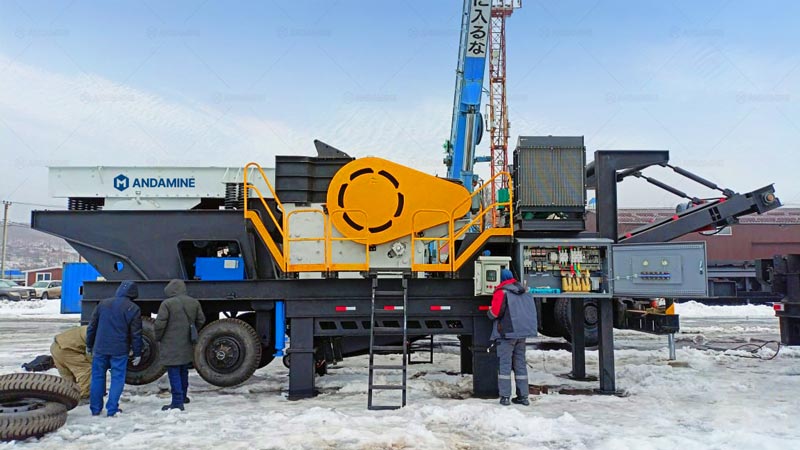
For quarry operators, the most effective screening configuration is the one that consistently delivers the required aggregate grading while maintaining balanced equipment utilization. AIMIX and its Andamine crushing solutions can be configured with different screening arrangements to match specific production requirements. By evaluating screen aperture alongside impact crusher or cone crusher(trituradora de cono) performance, operators can optimize the entire aggregate crushing plant rather than treating screening as an isolated process. This approach helps maintain product quality, control operating expenses, and make better-informed decisions when evaluating stone crusher price and future equipment investments.